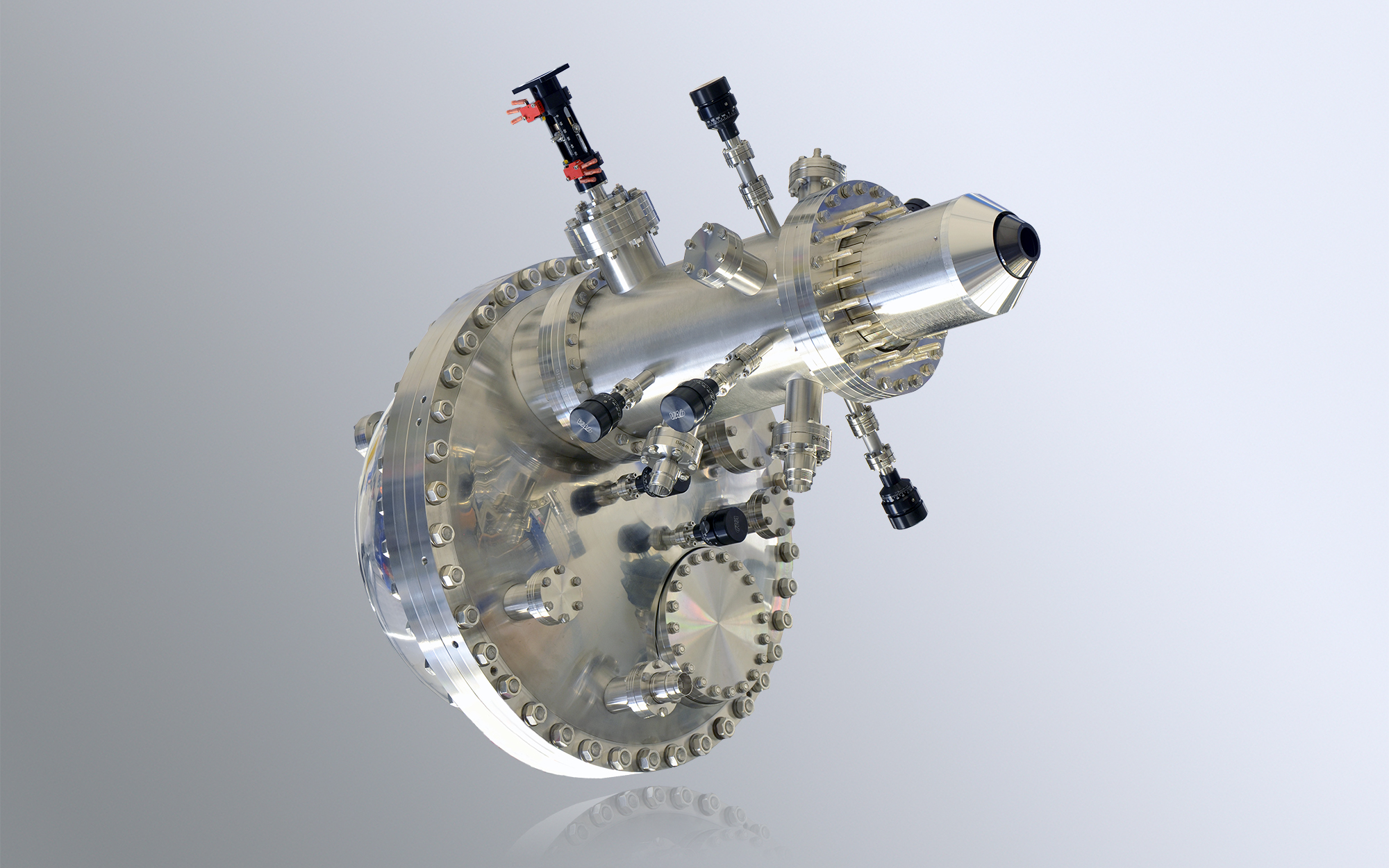
Astraios 190
The ASTRAIOS 190 is a revolutionary ARPES analyser for 2D momentum mapping. It is based on a direct k-mapping single spot shifting lens with a virtual entrance slit for ultimate k- and energy resolved measurements.

Key Features
- Single spot parallel shifting lens (patent pending)
- ± 30° acceptance angle
- ± 1 Å-1 k-range for He I, ± 2.5 Å-1 k-range for (S)XPS
- k-resolution < 0.003 Å-1
- Energy resolution better than 1.5 meV
- Motorized virtual analyser entrance slit
- 2D CMOS Detector with SPIN option
- Double µ-Metal Shielding
Direct k-mapping Lens
The lens of the ASTRAIOS is optimised for 2D momentum mapping. The parameters that are imaged by the hemisphere are the k-parallel components and the energy of the photoelectrons recorded with a minimum amount of data transformations. A revolutionary approach that we first pioneered in the KREIOS analyser family and which we can offer now for the ASTRAIOS as well, optimised for extraction field-free experiments for the ASTRAIOS.
Wide Acceptance Angle
A completely new objective lens allows for wide acceptance angles of up to ± 30° at 27.5 mm working distance. This is possible due to its significantly smaller spherical aberration than that of conventional ARPES lenses. The outer contour is shaped to be compatible with all kinds of UV sources, lasers and synchrotron geometries.
Single Spot Parallel Shifting Lens
The lens of ASTRAIOS 190 is unique in many aspects and thus a patent is applied for the new design. One of the most important design aspects is the parallel momentum imaging: the divergent beam of electrons coming from the sample is converted into a perfect parallel bundle of electrons in the entrance plane of the analyser. This is achieved by focusing the electrons into a sharp spot in the first real space image. A single shifting electrode assembly in this plane can shift the momentum image such that the full momentum space mapping can be performed on the full acceptance cone of the accepted electrons.
Motorised Virtual Entrance Slit
The ASTRAIOS 190 features a completely new and revolutionary entrance slit concept: the virtual entrance slit. Instead of placing the slit in the entrance plane of the analyser, the ASTRAIOS has its entrance slits in an electron-optically equivalent plane RP1 in the lens. The advantage of inserting the entrance slit in in the lens is that the kinetic energies are typically one order of magnitude higher than in the entrance plane of the analyser. The virtual entrance slit enables long-term operation at highest resolutions and detector homogeneities, increasing uptime and productivity. The motorisation and complete software control finally allows for programmable experiments, making ARPES experiments easier to perform.
Direct Counting 2D-CMOS Detector with 2D/3D Spin Option
The ASTRAIOS is equipped with our newest detector development: the 2D-CMOS detector. This detector offers true pulse counting with excellent linearity, extremely high dynamic range, highest count rates and pixel resolution. Combinations with 2D/3D spin detectors (Mott or VLEED) are available.
PerformanceEnergy Resolution < 1.5 meV Angular Resolution < 0.1° k-Resolution < 0.003 Å-1 Acceptance Angle ARPES ±30°, ±20° and ±10°
XPS ±10°Detector Channels 1285×730 (with Channel Binning) OperationKinetic Energy Range 0-1500 eV Pass Energies 0-100 eV Continuously Adjustable Energy Dispersion Hemisphere Lens Modes Angular Resolved Mode
Angular Resolved XPS Mode
Alignment ModeMeasurement Modes Snapshot Mode, Sweeping Mode, Fixed Energy Mode Detector 2D CMOS Detector Slits/Apertures 8 motorized entrance and 3 exit slits and iris aperture Electronics HSA 3500 + Working Pressure 10-11 to 10-7 mbar MountingWorking Distance 27.5 mm Mounting Flange DN150CF (8″ OD) with single µ-metal connection (ARPES)
DN200CF (10″ OD) with dual µ-metal connection (Laser ARPES)Magnetic Shielding Double µ-Metal Shielding