Hard X-Ray XPS (HAXPES)
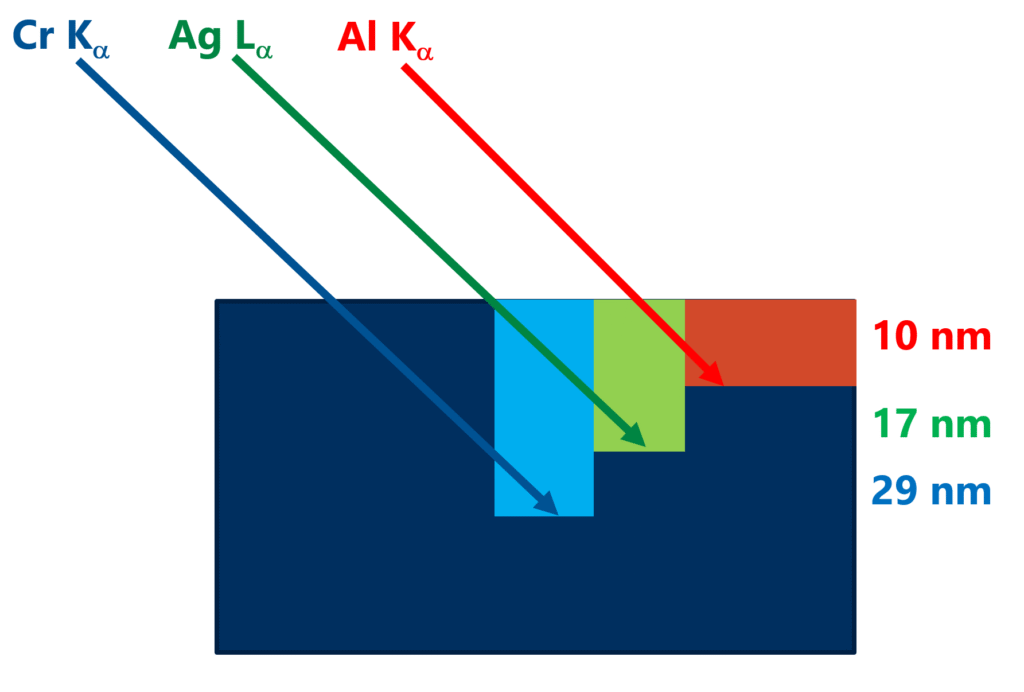
Conventional X-Ray Photoelectron Spectroscopy (XPS) is a surface-sensitive probe of the sample chemistry with an information depth of approximately 1 – 2.5nm or <10 atomic layers. It uses an X-Ray photon energy of ~1.5keV. In HAXPES higher energy X-Rays in the range of 3-15keV are used which allows a much greater information depth up to ~25nm to be probed. This enables measurements of buried interfaces and bulk properties that would be impossible with conventional XPS.
For more information
Hard X-Ray XPS (HAXPES)
Conventional X-Ray Photoelectron Spectroscopy (XPS) is a surface-sensitive probe of the sample chemistry with an information depth of approximately 1 – 2.5nm or <10 atomic layers. It uses an X-Ray photon energy of ~1.5keV. In HAXPES higher energy X-Rays in the range of 3-15keV are used which allows a much greater information depth up to ~25nm to be probed. This enables measurements of buried interfaces and bulk properties that would be impossible with conventional XPS.
Key Features
• Measure bulk properties, buried interfaces and core levels as well as the top surface
• Choice of synchrotron or laboratory-based systems
• Non-destructive analysis of complex layered or buried structures
Hard X-Ray XPS (HAXPES)
Conventional X-Ray Photoelectron Spectroscopy (XPS) is a surface-sensitive probe of the sample chemistry with an information depth of approximately 1 – 2.5nm or <10 atomic layers. It uses an X-Ray photon energy of ~1.5keV. In HAXPES higher energy X-Rays in the range of 3-15keV are used which allows a much greater information depth up to ~25nm to be probed. This enables measurements of buried interfaces and bulk properties that would be impossible with conventional XPS.
Key Features
• Measure bulk properties, buried interfaces and core levels as well as the top surface
• Choice of synchrotron or laboratory-based systems
• Non-destructive analysis of complex layered or buried structures